Maplewood, South Orange, and Millburn are using ALPR cameras (automated license plate recognition) in various locations.
Millburn has cameras at the intersection of Millburn Ave and Vauxhall Road, the intersection of Millburn Ave and Short Hills Ave, and on Route 510 through the South Mountain Reservation.
I haven't found any locations for cameras in Maplewood but the township awarded a bid of $52,839.20 for ALPR cameras in December 2025 and the police department was conducting training earlier this year.
I think the only option is to make sure that this information is never used for unofficial purposes or in a manner that violates our Constitutional rights. Easier said than done, I am sure, but easier that trying to put the technology genie back in the bottle.
I always thought information like this should be encrypted and only unlockable with a judge’s order in the event of a criminal investigation. Back when surveillance cameras were becoming ubiquitous, my thought was go ahead and record stuff but you can’t access it unless there was a reported crime.
I was naive, I would say now. There’s no such this as inaccessible information once it’s been captured. Someone will set their password to “password1”, or decide that someone else’s personal information is worth a bribe of few hundred bucks. Or neglect to update their operating system to something more secure because it’s too much of a hassle.
We have watched lots of police procedural dramas over the years. I’ve lost my taste for them recently but they make very liberal use of surveillance footage to catch bad guys. We’re watching “Person of Interest” now, which maybe in 2012 seemed far-fetched. The central premise is a computer system that can collect and analyze data from millions of sources (email, cell phones, surveillance cameras etc) and make highly accurate predictions about pending terrorist and criminal activities. Given what’s happening with AI and increases in computing power, this seems a lot more likely sooner rather than later.
My point is that here we have one more piece of technology that is creating and storing a whole new set of data points about pretty much everyone who owns a car.
I think the only option is to make sure that this information is never used for unofficial purposes or in a manner that violates our Constitutional rights. Easier said than done, I am sure, but easier that trying to put the technology genie back in the bottle.
The technology could be restricted or eliminated entirely. A municipality or state or the whole damn country could say “no, you can’t collect data on everyone all the time” and pass a law against use of things like license plate scanners.
But one of the worst labels for a politician is being “soft on crime”. And voting to eliminate plate scanners or speed cameras or surveillance cameras is an easy way to get labeled that way.
It is for privacy reasons that my family has opted never to use things like a ring camera. I know that these cameras exist all over the place and that every time I take my dog for a walk, video of me and the dog is on many people's camera feeds. I really hate that, but there isn't much I can do about it. but at least I don't contribute by not participating in that ecosystem at all.
I guess the issue with the traffic cameras is illegal tracking of people's movements. It's is easier to trace a person via license tag than by face recognition. With that said, one road I have to go on a lot (rte 1 in Philadelphia, aka Roosevelt Blvd) used to be one of the worst accident corridors in the US and since they put in speeding cameras it's got a lot better. The AI summary tells me:
"Automated speed enforcement cameras on Roosevelt Boulevard have significantly improved safety, with data showing a 95% reduction in speeding violations, a 21% drop in fatal and severe injury crashes, and a 50% decrease in pedestrian accidents since their implementation in 2020."
If these cameras could enforce laws about cars yielding to pedestrians I might grudgingly go along with it. Not sure, but at least thinking about it.
"We must negate the machines-that-think. Humans must set their own guidelines. This is not something machines can do. Reasoning depends upon programming, not on hardware, and we are the ultimate program! Our Jihad is a "dump program." We dump the things which destroy us as humans!"― Minister-companion of the Jihad
NJ banned traffic cameras several years ago, so I asked Google how towns can use ALPR cameras. Here is the answer I got:
New Jersey banned automated red-light and speed-enforcement cameras, but Automated License Plate Reader (ALPR) systems (such as Flock Safety cameras) are legally distinct.
Towns and police departments use ALPRs for investigative tracking and public safety rather than automated traffic ticketing
The Legal Distinction
Traffic Cams: Designed to catch moving violations (like speeding or running red lights) and automatically mail tickets to vehicle owners. New Jersey phased these out due to due-process and reliability concerns.
ALPR Cams: Designed to photograph license plates and match them against hotlists (such as stolen cars, missing persons/Silver Alerts, or vehicles linked to active criminal investigations). They are treated as police investigative tools rather than automated ticket-writers.
How Towns and Police Use ALPRs
Hotlist Alerts: Real-time alerts are sent to law enforcement mobile terminals when a flagged or stolen vehicle passes a camera.
Crime Solving: Detectives use stored historical logs to trace travel patterns of suspect vehicles post-crime.
Data Sharing: Local police departments can share plate data across regional, state, or national networks depending on agency policies.
I support traffic enforcement cameras as long as the focus is safety and not revenue. If somebody is going, say, 40 mph, on Ridgewood Road, they should be ticketed.
If a camera is set up to flag cars with known issues, and alert authorities to that particular car, I think that that is reasonable. If on the other hand every single car that passes a license plate reader gets logged somewhere that they were in that location at that time, it starts to be a dangerous level of surveillance.
Why would Traffic enforcement cameras be banned while Tracking cameras are allowed. If you want to protect privacy it would make more sense for it to be the other way around
Why would Traffic enforcement cameras be banned while Tracking cameras are allowed. If you want to protect privacy it would make more sense for it to be the other way around
Problem with traffic enforcement cameras was that they had a significant error rate which resulted in some motorists receiving tickets for violations they did not commit. This is not the reason why some people are opposed to license plate readers.
Why would Traffic enforcement cameras be banned while Tracking cameras are allowed. If you want to protect privacy it would make more sense for it to be the other way around
Problem with traffic enforcement cameras was that they had a significant error rate which resulted in some motorists receiving tickets for violations they did not commit. This is not the reason why some people are opposed to license plate readers.
Key Reasons for the Ban (traffic enforcement cams)
Revenue over Safety: Critics and investigations showed that private companies running the equipment profited heavily from tickets, leading to accusations of policing for profit. [1, 2]
Timing Manipulation: Some participating municipalities improperly shortened yellow-light durations to increase ticket volume, which actually raised accident rates at certain intersections. [1]
Constitutional and Privacy Concerns: Opponents argued automated ticketing violated drivers' civil liberties and the constitutional right to face one's accuser in court. [1]
Operational Errors: The automated systems experienced frequent technical errors, calibration disputes, and administrative frustration for drivers receiving delayed notices in the mail. [1, 2, 3]
--------------------------
License plate cams are tracking and collecting data on everyone, but traffic violation tickets are not being issued. In my opinion, there are serious privacy issues with the tracking cams. There are numerous documented cases where the cameras and data have been abused by law enforcement.
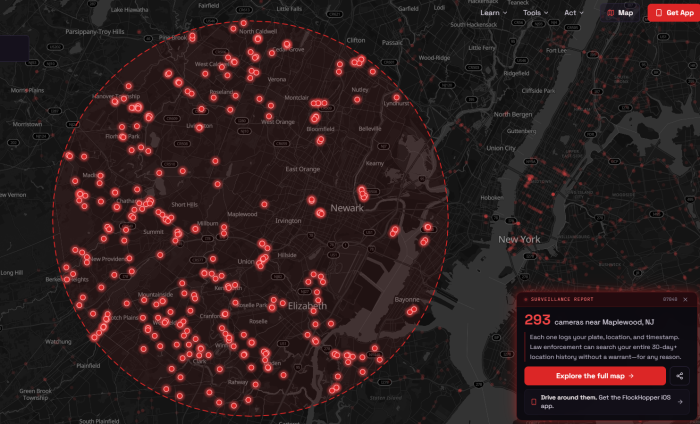
This screenshot is from a website called FlockHopper. The red dots are cameras near Maplewood. It looks like the radius is about 10 miles. The text is hard to read but it says there are 293 cameras near Maplewood.
Around here, we have a serious rash of cars on the road with no plates, or plates in the rear window, or plates obscured behind dark smoky covers. Do you see this in NJ? It creeps me out, and i wish the license plate laws could be better enforced, but do you suppose it's partly to do with the cameras??
Around here, we have a serious rash of cars on the road with no plates, or plates in the rear window, or plates obscured behind dark smoky covers. Do you see this in NJ? It creeps me out, and i wish the license plate laws could be better enforced, but do you suppose it's partly to do with the cameras??
I will be vilified for this, but often here it's ICE enforcement agents. No tags, no responsibility for their actions. Only postal workers don't have to have license plates, but yet, here they are...
The sharing of data is what worries me. That list above of uses lists a few things I would consider "good" and then adds that the information can be shared with any leads cal, county, state, or federal agency if the town allows it. That includes, of course, ICE. And once it leaves our town we don't control the data any longer.
KarenMarlowe, no vilification here. Wouldn't it be sweet if local cops could stop them for it? (actually i'm visualizing a safe chase, with those tire-ripping strips, but it's late & i'm losing it)
Article may be unlocked but you still need to create an account to read it. That requires providing your email address or giving NYT access to your google or apple account.
Article may be unlocked but you still need to create an account to read it. That requires providing your email address or giving NYT access to your google or apple account.
Here are a few passages:
Flock’s 120,000 cameras can be found alongside roads in every state but Alaska, allowing law enforcement officers to see within seconds where a car might be, and where it has been. The company has contracts with 7,000 law enforcement agencies, which is 40 percent of all departments in the United States.
Other companies sell license plate tracking services, but Flock, a private company valued at $8.4 billion, has become a lightning rod because of its rapid expansion, the ubiquity of its cameras, and a number of controversies involving its product.
What sets Flock’s cameras apart is that they are connected, creating a vast, searchable national network — often surprising residents who didn’t realize their local governments had signed up for them and raising fears of Big Brother-style surveillance. And they are hard to miss once you start noticing them.
Flock charges around $3,000 per camera per year, Mr. Langley said. In exchange, the company installs and maintains the cameras, provides a searchable database of every vehicle that passes them, and sends alerts if the cameras spot cars on a so-called hot list — like the F.B.I.’s database of stolen vehicles and license plate numbers associated with missing or wanted people. In recent years, as artificial intelligence has advanced, Flock has added the ability to search for cars based on their make, type, color, or unique details, such as bumper stickers or visible damage.
Flock showed The New York Times how its technology works. After logging into the system, users must acknowledge they cannot search for license plates related to “reproductive care” offenses in 17 states and Washington, D.C. (Those places have expressly prohibited those searches, though a Flock spokeswoman said officers could do searches related to abortions in states only where abortion is illegal.) There is a similar warning about nine states that prohibit searching their cameras for “immigration enforcement.”
Around here, we have a serious rash of cars on the road with no plates, or plates in the rear window, or plates obscured behind dark smoky covers. Do you see this in NJ? It creeps me out, and i wish the license plate laws could be better enforced, but do you suppose it's partly to do with the cameras??
I will be vilified for this, but often here it's ICE enforcement agents. No tags, no responsibility for their actions. Only postal workers don't have to have license plates, but yet, here they are...
Nixon made the Postal Authority a separate entity apart from all federal regulations in 1970, which sets its own rules. That's why the trucks can have right side driver seats, no plates, and the carriers be friendlier than other government workers.












Maplewood, South Orange, and Millburn are using ALPR cameras (automated license plate recognition) in various locations.
Millburn has cameras at the intersection of Millburn Ave and Vauxhall Road, the intersection of Millburn Ave and Short Hills Ave, and on Route 510 through the South Mountain Reservation.
https://maps.deflock.org/?lat=40.7339&lng=-74.2976&zoom=12.63
South Orange has a camera at the intersection of Irvington Ave and Seton Place.
https://maps.deflock.org/?lat=40.7403&lng=-74.2518&zoom=14.00
I haven't found any locations for cameras in Maplewood but the township awarded a bid of $52,839.20 for ALPR cameras in December 2025 and the police department was conducting training earlier this year.
https://ecode360.com/documents/MA1203/public/753205815.pdf
https://ecode360.com/documents/MA1203/public/753242905.pdf
https://ecode360.com/documents/MA1203/public/753257128.pdf